

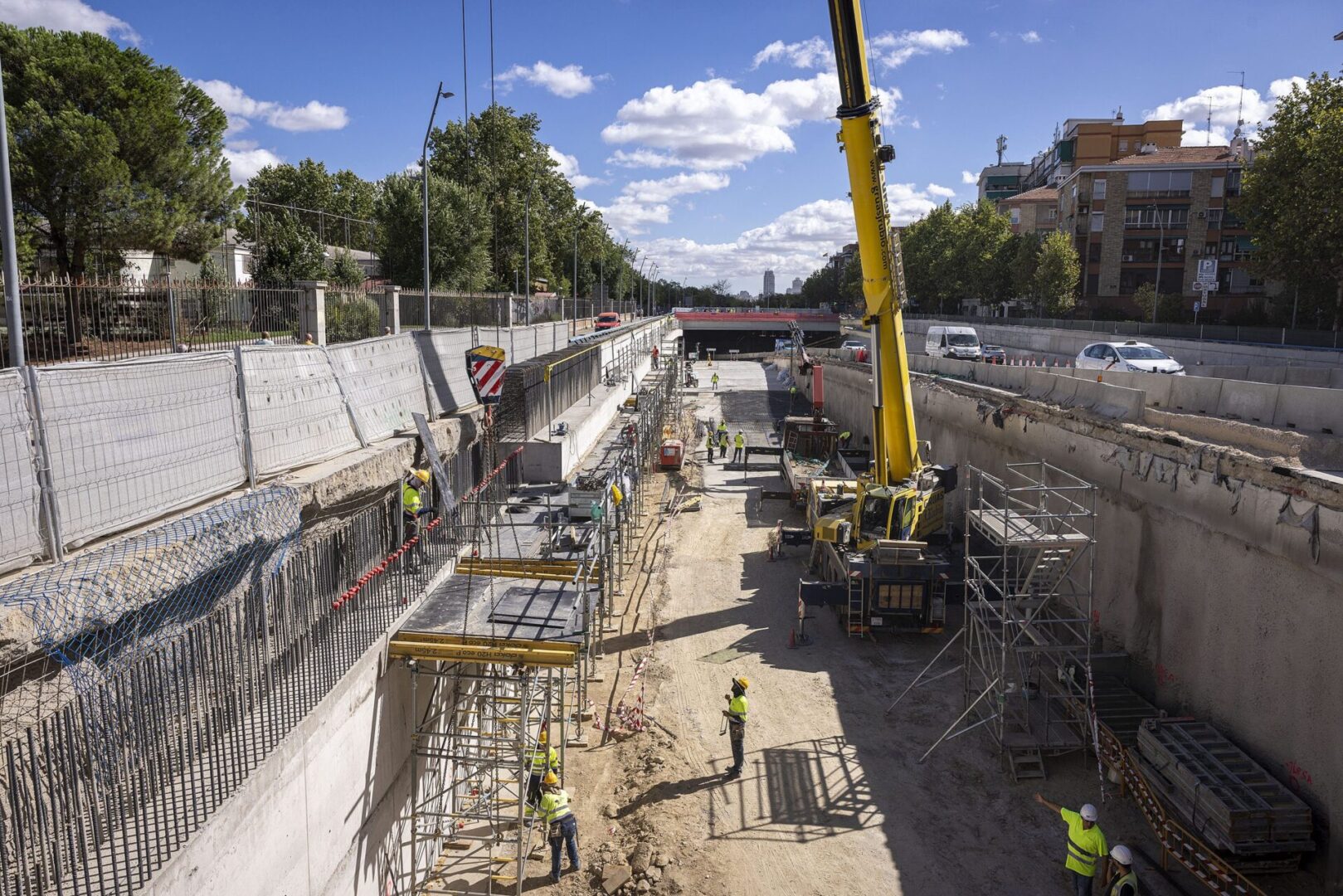
- M-30 tunnel connecting Avenida de Portugal and the Extremadura Motorway (A-5) has reopened to traffic.
- The works have made it possible to complete one of the key milestones of the A-5 undergrounding project and have paved the way for connecting the new tunnel to the M-30 network.
- Over the past three weeks, the old ramp deck has been demolished, the new structure has been built, and 14 beams measuring 30 metres in length have been installed.
- The tunnel’s civil engineering works will be completed in September, paving the way for the transformation of the surface area into the Paseo Verde del Suroeste.
Madrid.es
Madrid has completed part of the preliminary works this summer to permanently underground the A-5 motorway. The City Council has finished the operations required to prepare the future connection between the new A-5 tunnel and the M-30 underground tunnel running beneath Avenida de Portugal. On Monday, Borja Carabante, Madrid’s Deputy Mayor for Urban Planning, Environment and Mobility, visited the site to inspect the completion of the works, which required the closure of the outbound M-30 tunnel throughout August.
Carabante highlighted the importance of having completed, on schedule, one of the final major milestones of a project that will transform this area of the city. The project will eliminate the A-5 as a barrier dividing neighbourhoods and instead create a new public space for residents.
The works, carried out over the planned three-week period, focused on demolishing the concrete slab of the exit ramp from the existing tunnel, excavating down to the final grade level, and constructing the new structure that will allow both infrastructures to be seamlessly connected. Fourteen 30-metre-long, heavy-duty beams were also installed, spanning the entire distance between the northern and southern abutments. Their installation took place at night using a large-capacity crane in a particularly complex operation that required occupying the full width of the tunnel carriageway.
The work now completed represents one of the final steps in the civil engineering phase required to finish the new A-5 tunnel. Equivalent works on the inbound tunnel to Madrid were carried out during the summer of last year, enabling progress on connecting the new infrastructure to the M-30.
With the connection of both tunnels now virtually complete, the civil works for the A-5 undergrounding project are entering their final stretch. Completion is scheduled for September, after which urbanisation works will begin on the surface area that will be freed up by the project.
A Historic Transformation
The undergrounding of the A-5 will remove one of Madrid’s main urban barriers from the surface and return more than 100,000 square metres of public space to residents. This area will become the Paseo Verde del Suroeste, a new 3.2-kilometre nature-based corridor connecting Madrid Río, Casa de Campo, and the Latina Green Wedge (Cuña Verde de Latina).
The project will reconnect neighbourhoods located on either side of the A-5, particularly in the Latina and Moncloa-Aravaca districts, which have been divided for decades by an infrastructure currently used by approximately 80,000 vehicles per day. Crossings between both sides will be reduced by 90%, significantly lowering traffic-related pollution. In addition, a new public space will be created for the enjoyment of local residents and the wider city, featuring expanded green areas, pedestrian and cycling routes, and improved connections between neighbourhoods.
With an investment of more than €400 million, the A-5 undergrounding project is one of the largest urban regeneration initiatives currently being carried out by Madrid City Council, both in terms of the scale of the infrastructure and the transformation it will bring to the surrounding area. With the completion of the connection to the M-30, the project is entering its final phase.
The goal is that, once the tunnel works and the surface redevelopment are completed, Madrid residents will be able to enjoy a new urban space that replaces a road infrastructure which, since 1968, has separated communities across several neighbourhoods in the southwest of the capital.