

Madrid.es
-
The project is being promoted by Casa 47 Public Business Entity and will be overseen by the City Council, through the Department of Public Works and Facilities.
-
The works associated with this new development will constitute one of the most significant urban regeneration projects in the country, involving an investment of more than €383 million.
-
The development of the area, which will be carried out in three phases, includes 22 green spaces and the planting of more than 8,000 trees.
The Madrid City Council has granted final approval to the Campamento urbanization project in the Latina district, a new development that will include approximately 11,350 homes, 65% of which will be protected (affordable) housing. The announcement was made by Deputy Mayor and City Council spokesperson Inma Sanz following the weekly meeting of the Governing Board.
The project, promoted by Casa 47 Public Business Entity, will be overseen by the City Council through the Department of Public Works and Facilities and will involve an investment of more than €383 million.
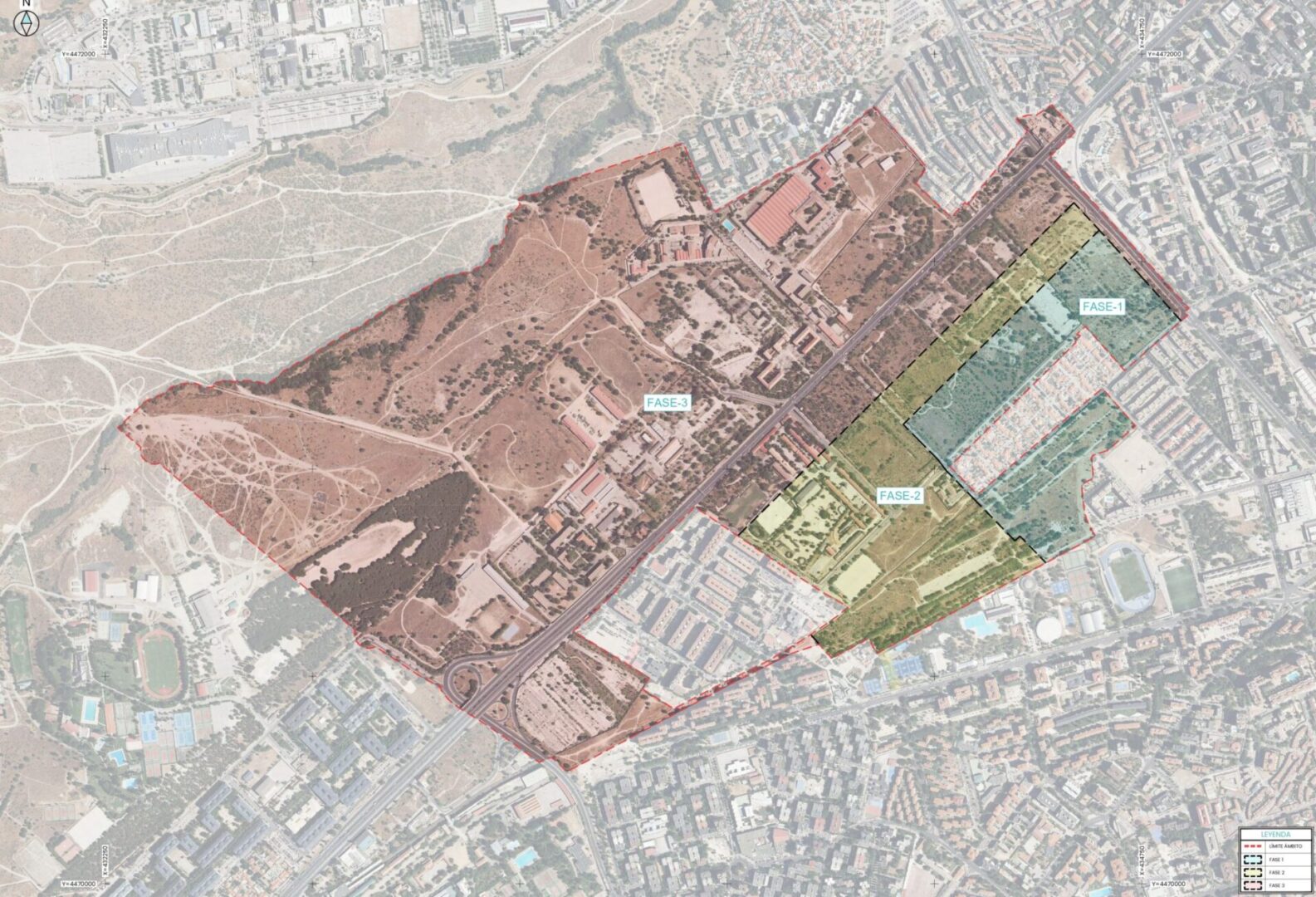
The area is located on the southwestern edge of the city and is organized along Paseo de Extremadura as its main longitudinal axis, in the section between Avenida de los Poblados and Avenida de la Aviación, within the neighborhoods of Campamento (to the north) and Las Águilas (to the south). Meanwhile, the Valchico stream forms the northern boundary of the development area.
With more than two million square meters of surface area, the project will represent one of the most significant urban regeneration initiatives in the country and will enable the integration and connection of this part of the city with the adjacent metropolitan and regional areas (Pozuelo de Alarcón and Alcorcón). It will also create a significant new housing supply and provide facilities and spaces for residents, addressing community infrastructure needs. All of this will be carried out under the principles of sustainability and energy efficiency.
Nearly 11,000 homes, 65% with some form of protection
The total area of this new development is 2,110,206 m². Residential building rights amount to 1,134,994 m², allowing for the construction of approximately 11,350 homes, of which 65%—more than 7,000 homeswill have some form of protected housing status.
Of the remaining area, 93,340 m² of building rights will be reserved for retail uses and 59,048 m² for offices. The area allocated to public networks and facilities totals 1,563,420 m². Among the main uses, 560,980 m² are dedicated to the local urban services network (internal roads); 210,872 m² to tree-lined public spaces; 180,904 m² to local social facilities; 154,169 m² to green areas; 147,719 m² to public-service facilities; and 23,074 m² to social infrastructure facilities.
22 green areas and more than 8,000 new trees
A total of 22 green areas are planned within the development, including the established pine forest of the La Dehesa Military Sports Centre and the park located at the northwestern edge of the site, crossed by the Valchico stream. The project includes the planting of more than 8,000 trees. In addition, the existing facilities of the Army Geographic Service and the Military Veterinary Centre will be retained as public facilities.
The urbanisation works are planned to be carried out in three phases, which may be undertaken independently or jointly. Phases 1 and 2 cover the land located in the southern part of the site and are intended for coordinated development, although they may also proceed independently. Phase 3 includes the land on both sides of the A-5 motorway and the areas located north of this infrastructure. The main reason for dividing the project into functionally independent phases is that the design and subsequent construction of the undergrounding of the A-5 motorway through the site are still pending, and the specifications of that project will influence the urbanisation plan.